Showing posts with label Craig Berwyn. Show all posts

Tuesday, 10 December 2019

Mapping Mountains – Trimble Surveys – Y Berwyn


13.09.19  Craig Berwyn (SJ 071 323), only bwlch surveyed

It felt good to be standing in a bog.  I hadn’t done this for a number of weeks and the heather bound morass where the bog was situated was a delight with the first purples of bloom and vivid late afternoon greens picked out by a lowering sun.  Not surprisingly I had the bog all to myself, although the road passing over the Y Berwyn was no more than a couple of minutes’ walk away.  I wondered why more people weren’t stopping to savour the bog’s delight.  They didn’t know what they were missing.

The summit of Craig Berwyn (SJ 071 323)

I wonder if Bog Bwlch Surveying has ever trended on the Internet, if it hasn’t it should as it has a surreal appeal all to its self.  This particular bog is connected to the highest point of the Y Berwyn; Craig Berwyn and if not for the near road it would be a quiet spot, however its water laden depths must surely be seldom visited other by a rogue sheep or scampering fox.

I’d come prepared with a ten figure grid reference initially produced by Aled Williams from LIDAR analysis, and afterward also by myself.  LIDAR only has partial coverage for the area of this bwlch, but what is covered is sufficient to produce a grid reference within a metre or two of its critical point.

LIDAR bwlch image for Craig Berwyn

LIDAR close up bwlch image for Craig Berwyn

This was the last of six such roadside surveys during the day and all under a succulent blue sky and sunshine to savour.  As I left my car I walked over the road and immersed myself in heather, this can be rather comforting if soft and especially so if the experience is not protracted.  Today was one such occasion, with just a few minutes spent in the bog laden heather bound morass, just enough to enjoy and not too much to detract.

Considering the amount of heathered surrounds it would not be too difficult a task to pinpoint the bwlch without the aid of LIDAR, but having the all-important ten figure grid reference led to the critical point and within a few minutes the Trimble was set-up gathering data. 

Gathering data at the bwlch of Craig Berwyn

During data collection I tried in vain to find a dry patch of ground to stand on, to be fair the bog was not too bad compared to some whose delights I’ve experienced, but it was never the less a watery haven.

Once the allotted data were gathered and stored I closed the equipment down, packed it away and looked out across the heather to distant hills and a blued horizon, what a stunning place.


Survey Result:


Summit Height:  832.0m (converted to OSGM15, from previous Trimble GeoXH 6000 survey)

Summit Grid Reference:  SJ 07163 32351

Bwlch Height:  484.7m (converted to OSGM15)

Bwlch Grid Reference:  SJ 01628 30532

Drop:  347.3m

Dominance:  41.74%


Friday, 8 July 2016

Mapping Mountains – Significant Name Changes – Y Pellennig, Yr Uchafion, 800m Twmpau and Y Trechol - The Dominant Hills of Wales


Craig Berwyn (SJ 071 323)

There has been a Significant Name Change to a hill that appears in the following lists; Y Pellennig, Yr Uchafion, 800m Twmpau and Y Trechol - The Dominant Hills of Waleswith the following details relating to a hill whose summit was surveyed with the Trimble GeoXH 6000 on the 21st June 2014 and its bwlch on the 13th September 2019.

The criteria for the four listings that this name change affects are:

Y Pellennig –The Remotest Hills of Wales comprise all Welsh hills whose summit is 2.5km or more from the nearest paved public road and which have a minimum 15m of drop.  The list is co-authored by Myrddyn Phillips and Aled Williams.

Yr Uchafion - All Welsh hills at or above 500m in height that have 15m minimum drop.  The list is co-authored by Myrddyn Phillips and Aled Williams. 

800m Twmpau - All Welsh hills at or above 800m and below 900m in height with 30m minimum drop.  The list is authored by Myrddyn Phillips.  

Y Trechol - The Dominant Hills of Wales - These are the Welsh P30 hills whose prominence  equal or exceed half that of their absolute height.  With the criteria for Lesser Dominant status being those addition Welsh P30 hills whose prominence is 33% or more and below 50% of their absolute height.

The hill is situated in the Y Berwyn, which is an extensive group of hills positioned in the south-eastern part of north Wales, and is relatively remote for a Welsh hill with the nearest towns being Llandrillo to the north-west and Llanarmon Dyffryn Ceiriog to the east.

The Trimble GeoXH 6000 gathering data at the summit of Craig Berwyn (SJ 071 323) with the trig pillar atop Cadair Berwyn (SJ 072 327) in the background on the left

The hill first made an appearance in a hill list as Cader Berwyn, S. Top in a 1929 update to the Twenty-Fives which was compiled by John Rooke Corbett and published by the Rucksack Club Journal.  Since this time the hill has been listed a number of times and usually by names associated with that of Cadair Berwyn, which strictly speaking is the hill to its north positioned at SJ 072 327, and which has a triangulation pillar situated at its summit and a map height of 827m.

Unfortunately all previous hill list authors have used the map name that appears nearest to the summit of this hill, although doing this is convenient it has conjured up all manner of  combinations of inappropriate names centred around that of its adjacent hill, these names include; Cadair Berwyn New Top, Cadair Berwyn South Top as well as the use of the adjacent hill’s name; Cadair Berwyn.

The hill was only confirmed by the Ordnance Survey as the highest in the Y Berwyn when contacted by Bernard Wright who had recognised that the summit of the hill was higher than its adjacent northerly peak; Cadair Berwyn, and also higher than its adjacent southerly peak; Moel Sych, Bernard suggested the name of Craig Uchaf for this hill as it seemingly had no name for it on the map of the day.  This is the name previously given the hill in unpublished format within the Yr Uchafion prior to extensive place-name research for this area taking place.

As a result of this research the hill has subsequently appeared under the name of Craig Berwyn in all four of the previously mentioned lists, this is the name that some local farmers and shepherds know the hill by, ironically this name already appears on Ordnance Survey 1:50,000 Landranger and 1:25,000 Explorer maps.


The full details for the hill are:

Group:  Y Berwyn

Name:  Craig Berwyn

Previously Listed Name:  Craig Uchaf 

Summit Height:  832.0m (converted to OSGM15)

OS 1:50,000 map:  125

Summit Grid Reference:  SJ 07163 32351 
 
Drop:  347.3m

Dominance:  41.74%


Myrddyn Phillips and Aled Williams (July 2016)


Monday, 27 July 2015

Mountain Biking the Hill Boundary of Powys - Day 2


25 years ago today I set off with a good friend; Mark, on the second day of our attempt to circumnavigate by bicycle Wales’ largest county; Powys.  To add interest to the venture we planned on visiting the highest point of each of the eight 2,000ft hill ranges within the county, which are all situated around its periphery, bikes included.  We were backed up by Hazel and Barry; without whom our little adventure would not have taken place.  Prior to setting off and during our trip we raised money for the British Heart Foundation and the Ystradgynlais Mountain Rescue team.

The following is an account of this ten day expedition with each day’s journey appearing on the Mapping Mountains blog 25 years after it had taken place.


The county of Powys with the eight 2,000ft hill ranges positioned around its periphery

Day 2

27.07.90 – The Berwyn – Bwlch y Groes – Dinas Mawddwy

As I opened the tent flap I was confronted by a misty scene with the hill ridges and blue sky of the previous evening now replaced with a lowering cloud base and a chill in the air.  We were soon up and met the local farmer who was heading up the near track, we chatted for a number of minutes and told him all about what we were doing and the route ahead, he wished us luck.  After washing in the steam which trickled past the tent only a couple of metres from where we had slept, Hazel brought out breakfast from the back-up camper van, this we devoured as we got the bikes ready.

Our first camp site with Mark taking an early morning wash in the stream

We arranged to meet Barry and Hazel on top of the Llangynog to Bala road at approximately 12.30pm and then waved our goodbyes as we headed off into the mist.  The route we had opted for to get to the high point of the Berwyn continued on a track to the head of Cwm Maen Gwynedd before entering a small conifer plantation, the track continued through this wood and gained height toward the main Berwyn ridge. 

As we left the conifers high on the steepening eastern face of Craig Berwyn the mist was being whipped around the hillside by wind, which also brought rain, we wrapped up and continued uphill carrying the bikes as best we could.  Thankfully a gap in the mist appeared and we made a mental note of our route up onto the main ridge.  I found carrying the bike in worsening weather conditions to be absolutely knackering and wondered what the next nine days had in store for us.

Arriving on the ridge near to the summit of Craig Berwyn

When we reached the summit of Craig Berwyn I took a photograph of Mark with bike in hand beside the summit rocks, one down, seven more to go!  We set off from the high point over Moel Sych and continued through the mist, wind, rain and heather on a compass reading.

Mark at the summit of Craig Berwyn, the high point of Y Berwyn.  One down, seven more to go.

Progress was haphazard and slow as heather is not conducive to fast mountain biking, time and again the bike would hit a large tussock and flip over throwing each of us onto a soft cushioned landing to the heather below.  At one point Mark just lay in the heather not wanting to move.  Eventually we spotted the road and yelped for joy and cycled northward to our pre-arranged meeting place with Barry and Hazel.  When we arrived we were met with cake, butties and mug after mug of tea.

Mark taking a rest in the heather

By now the rain had stopped, but this was only an intermission as by the time we left the comforts of the camper van it had started again.  The four miles downhill toward Bala was bliss, it felt great to be making quick progress after a morning’s exertion in mist and heather.

As we neared Llyn Tegid we left the B 4391 and turned left onto the B 4403, it was here that we met two men out on their bikes; we couldn’t resist the temptation to stop and take a photo. 

We did think of asking them if they would like to join us

Cycling along this B road with the lake on our right was peaceful as hardly any vehicles passed us, we turned left just before Llanuwchllyn onto a narrow lane that heads south beside the Afon Twrch, this road culminates at Bwlch y Groes and it is the second highest public road in the whole of Wales, it was a road that I had driven on, on a number of occasions over recent years, but I had never cycled up it.  The going was decidedly slow and although the mist was still low on the surrounding hill tops the rain was now lighter and would soon stop.  We met the back-up vehicle at the large parking area on top of the road, had a rest and chat and then continued down toward Llanymawddwy.

At the top of Bwlch y Groes - the second highest public road in Wales

It was great to cycle down this road but by this time any minor uphill as we continued toward Dinas Mawddwy was a struggle and I felt completely knackered, to the point that when we arrived at the camp site on the outskirts of the village it took me hours to recover.

At our camp site on the outskirts of Dinas Mawddwy

When we did arrive Barry and Hazel had set up our tent and soon afterwards a meal had been prepared.  I tried busying myself with a few things that needed to be done, but all I wanted to do was rest and recover.


Tomorrow:  Dinas Mawddwy – Machynlleth – below Pumlumon     


Saturday, 30 August 2014

Mapping Mountains – Trimble Surveys – UKHillwalking Article


UKHillwalking recently published an article on the Trimble survey of the highest mountain in Y Berwyn; Craig Berwyn.  The article and a link to it on the UKHillwalking website appear below.

Thanks to Alan Dawson for photos and details on Bernard Wright, Peter Collins for details relating to Bernard Wright and Aled Williams for suggesting and having input in to the article.


In Search of the 'Lost' Welsh Mountain
Through painstakingly re-measuring some of Britain's borderline summits, independent surveyors G&J Surveys have been responsible for elevating mere hills to mountain status, and dethroning Munros. G&J's Myrddyn Phillips describes his recent work on the highest point of the Berwyns, a mystery mountain that's never before been given an accurate height, and one particularly close to his heart.
Over 25 years ago a party of 20 were walking on the Berwyn mountains in Mid Wales. The party was being led by Bernard Wright, a former motor oils scientist from Tarvin in Cheshire. As they headed up to the main Berwyn ridge they were confronted by a peak that was absent from their Ordnance Survey maps.
The pointed summit of Craig Berwyn (left) and nearby Cadair Berwyn
Bernard and his friends were standing beside the trig pillar on Cadair Berwyn looking south toward Moel Sych. Both hills nowadays are given the same metric height of 827m. In Bernard's day the map had Moel Sych at 2713ft, and Cadair Berwyn at 2712ft. But something was wrong. The map indicated that these two summits were the highest in the Berwyn, but between the two was another hill, a hill that looked higher, but was not shown as such on any map. 
"Between what the map said were the highest two summits in the Berwyn was another, higher hill"
The group visited the unknown and seemingly 'non-existent' hill and Bernard sat on its highest rock and peered out over the top of Cadair Berwyn and Moel Sych. This hill was definitely higher, but why wasn’t it shown as such on the map? As the friends descended, they chatted about the hill and someone proposed that they should name it Berwyn Wright. A Welsh friend in the party suggested the name Craig Uchaf (...highest), and although an appropriate name it has never caught on.
More recent research I conducted for the ‘Y Pedwarau’ hill list (see UKH article here) revealed that the peak is known to some of the local farmers and shepherds as Craig Berwyn, a name that already appears on the Ordnance Survey map.
Trimble GeoXH 6000 on the key spot

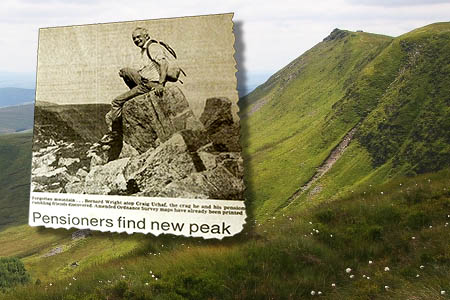
Newspaper clipping from 1988


Back in the Eighties, Bernard reported his find to the Ordnance Survey and was told that the two 827m peaks were the highest points for miles around. Dissatisfied with this answer he persevered and gave detailed co-ordinates for the peak. This prompted the OS to examine their large-scale mapping, on which was found a tiny 830m ring contour that did not appear on the publicly available 1:50,000 and 1:25,000 maps.
The news of Bernard’s ‘new mountain’ hit the headlines, and soon the tiny 830m ring contour appeared on the new OS 1:25,000 Explorer map. However, one thing the Ordnance Survey never did was to give the mountain an accurate absolute height, relegating it to among the few principal Welsh mountains that do not have definitive values for elevation. As the summit is made up of a number of embedded rocks, all jutting out of the ground, the height could well be higher than thought. If an accurate height was given to the mountain, it would also be the culmination of a story that first started over 25 years ago when Bernard Wright and his friends came across a mountain that seemed not to exist.
"The Ordnance Survey never gave the mountain an accurate absolute height"
Here's where I entered the story, armed with a new piece of equipment; the Trimble GeoXH 6000. This fancy bit of kit only weighs 2lb and can achieve accurate height results in no more than five minutes. 
The Trimble GeoXH 6000 is proving to be a great piece of equipment to ‘screen’ hills with, as its precision is +/- 0.15m when compared to our Leica GS15 whose accuracy is +/- 0.05m, but only when we collect upwards of two hours of data. Any hill measured quickly with the Trimble whose height is close to a recognised threshold, such as 2000ft or 3000ft, can then be more slowly surveyed to a higher degree of accuracy with our Leica equipment.
The Trimble GeoXH 6000 gathers its ten minutes of data on the high point of Y Berwyn
However, this particular hill was more than a lump of rock that I wanted to place a bit of surveying equipment on top of. It held an emotional tie for me too, as I had scattered some of my father’s ashes from its highest point. The height of the hill had intrigued me ever since I'd read about Bernard Wright’s new mountain in the late 1980s.
The trip to survey Craig Berwyn proved quite an expedition as I wanted to survey all eleven hills and their respective cols that make up the Maen Gwynedd Horseshoe. This is an extended walk I've done on many occasions but never with the intent to carry out so many surveys. Of course it was the high point of Craig Berwyn that really interested me.
I set out on the 21st June 2014. The surveying expedition would require many hours to complete, but I had settled weather, and the notorious peat paths of the higher Berwyn were dry. As the highest rocks of the Berwyn were approached a slight breeze picked up, but not enough to worry me as I placed the Trimble on the very highest point of the mountain range, the same spot that Bernard Wright had peered from all those years ago. The view from the summit took in all the higher Snowdonia peaks to the west as well as the lower hills towards the English border. In all the surveying trip took over 12½ hours to complete. 
Ten minutes of summit data were collected by the Trimble GeoXH 6000 and later post processed, giving a result of 831.98m +/- 0.15m.  So over 25 years since Bernard Wright first discovered the mountain its true height is now known, and at 832m it seems that the little 830m ring contour on OS maps is hiding quite a substantial rock under it!

Further details of this survey and others can be found on Myrddyn’s blog:


Please click {here} to see the original article published on the UKHillwalking website

Tuesday, 1 July 2014

Mapping Mountains – Trimble Surveys – Grough Article


Grough recently published an article on the Trimble survey of the highest mountain in Y Berwyn; Craig Berwyn.  The original article and a link to it on the Grough website appear below.

Thanks to Alan Dawson for photos and details on Bernard Wright, Peter Collins for details relating to Bernard Wright and Aled Williams for suggesting and having input in to the article.


Hill sleuth Myrddyn goes in search of the ‘missing’ Berwyn mountain


More than 25 years ago a party of 20 people from the Retired People’s Club were walking on the Berwyn Mountains in northern Mid Wales.
The party was being led by Bernard Wright, a former motor oils scientist from Tarvin in Cheshire. As they headed up to the main Berwyn ridge they were confronted by a peak that was absent from their Ordnance Survey maps.
Craig Berwyn
Bernard and his friends were standing beside the trig pillar on Cadair Berwyn looking south toward Moel Sych.
Both hills nowadays are given the same metric height of 827m. When Bernard looked south the map told him that Moel Sych was 1ft higher at 2713ft, compared to the 2712ft for Cadair Berwyn. But something was wrong as the map indicated that these two summits were the highest in the Berwyn, but between the two was another hill, a hill that looked higher, but was not shown as such on any map.
The group visited the unknown and seemingly non-existent hill and Bernard sat on its highest rock and peered out over the top of Cadair Berwyn and Moel Sych.
A newspaper cutting showing Bill Wright on the mountain. Main photo: Myrddyn Phillips
A newspaper cutting showing Bill Wright on the mountain.  Main Photo:  Craig Berwyn
This hill was definitely higher, but why wasn’t it shown as such on the map? As the friends descended, they chatted about the hill and someone proposed that they should name it Berwyn Wright, a Welsh friend in the party suggested the name Craig Uchaf and, although an appropriate name it has never caught on.
Research conducted for the ‘Y Pedwarau’ hill list (published by Europeaklist in 2013) revealed that the peak is known to some of the local farmers and shepherds as Craig Berwyn, a name that already appears on the Ordnance Survey map.
Bernard reported his find to the Ordnance Survey and was told that the two 827m peaks were the highest points for miles around. Dissatisfied with this answer, Bernard persevered and gave detailed co-ordinates for the peak, which prompted the OS to examine their large-scale mapping on which was found a tiny 830m ring contour that did not appear on the publicly available 1:50,000 and 1:25,000 maps.
The news of Bernard’s ‘new mountain’ hit the headlines with articles appearing in The Guardian as well as the Ramblers Association magazine, and soon the tiny 830m ring contour appeared on the new OS 1:25,000 Explorer map.
However, one thing the Ordnance Survey never did was to give the mountain an accurate absolute height, relegating it to among the few principal Welsh mountains that do not have definitive values for elevation.
As the summit is made up of a number of embedded rocks, all jutting out of the ground, the height could well be higher than thought. If an accurate height was given to the mountain, it would also be the culmination of a story that first started over 25 years ago when Bernard Wright and his friends came across a mountain that seemed not to exist.
The Trimble GeoXH 6000 perched on the very highest point of Y Berwyn
Enter a hill sleuth with a new piece of equipment: the Trimble GeoXH 6000.
This fancy piece of equipment only weights 2lb and can achieve accurate height results in no more than five minutes. The hill sleuth in question is Myrddyn Phillips who is a member of G&J Surveys, those infamous independent surveyors who have discovered new mountains and dethroned Munros.
Myrddyn said: “The Trimble Geo 6000 is accessible to the G&J team and is proving to be a great piece of equipment to ‘screen’ hills with, as its precision is +/- 0.15m when compared to our Leica GS15 whose accuracy is +/- 0.05m when we collect upwards of two hours of data.”
“Therefore any hill measured with the Trimble whose height is close to a recognised threshold, such as 2,000ft or 3,000ft can then be surveyed to a higher degree of accuracy with our Leica equipment.”
However, the hill was more than a lump of rock that Myrddyn wanted to place a bit of surveying equipment on top of. It held an emotional tie for him as he had scattered some of his father’s ashes from its highest point and the height of the hill had intrigued him ever since he had read the article about Bernard Wright’s new mountain years ago in the late 1980s.
The trip to survey Craig Berwyn proved quite an expedition as Myrddyn wanted to survey all eleven hills and their respective cols that make up the Maen Gwynedd Horseshoe.
This is an extended walk he had done on many occasions but never with the intent to carry out so many surveys. The hill sleuth told grough: “Although I wanted to survey every hill on the horseshoe it was the high point of Craig Berwyn that really interested me.”
The high Berwyn: Craig Berwyn, left, and Cadair Berwyn
He set out on 21 June as the surveying expedition would require many hours to complete and with the weather settled and the notorious peat paths of the higher Berwyn dry, it meant that he shouldn’t encounter any undue problems.
As the highest rocks of the Berwyn were approached a slight breeze picked up, although it wasn’t strong enough to worry Myrddyn as he placed the Trimble on the very highest point of the mountain range, the same spot that Bernard Wright had sat and peered out over the two adjacent and lower peaks all those years ago.
Mr Phillips said: “It was ideal as the breeze was only light and the view from the summit took in all the higher Snowdonia peaks to the west as well as the lower hills towards the English border.”
As he arrived back at his car the expedition had taken more than 12 ½ hours to complete.
Ten minutes of summit data were collected by the Trimble GeoXH 6000 and later post processed, giving a result of 831.98 +/- 0.15m. So over 25 years since Bernard Wright first discovered the mountain its true height is now known, and at 832m it seems that little 830m ring contour on OS maps is hiding quite a substantial rock under it.
Further details of this survey and others can be found on Myrddyn’s Blog
Please click {here} to see the original article published on the Grough website


Sunday, 22 June 2014

Mapping Mountains – Trimble Surveys – Y Berwyn


21.06.14  Mynydd Tarw (SJ 112 324), Pt. 687.9m (SJ 102 330), Foel Wen (SJ 099 334), Tomle (SJ 085 335), Cadair Fronwen (SJ 077 346), Craig Berwyn (SJ 071 323), Moel Sych (SJ 066 318), Pt. 694.7m (SJ 080 317) and Godor (SJ 094 307).

The high Berwyn, (L-R) Moel Sych, Craig Berwyn and Cadair Berwyn
Living in Welshpool the nearest ‘big’ walk for me is the Maen Gwynedd Horseshoe.  I’ve done this walk many times, with past and present hill walking friends as well as on numerous occasions by myself.  I’ve also surveyed some of the small prominence hills on the horseshoe with my old staff for possible P15 status, but I’ve never set out with the intention of surveying all eleven hills and ten bylchau that take in the whole horseshoe. 

The main advantages of using the Trimble is its internal antenna which enables accurate results to be attained with the use of one piece of equipment which weighs just 2lb, and staggeringly these accurate results can be attained with just two minutes of data collection, I knew from past experience that when planned survey points exceed ten the time on the hill dramatically increases, as even though the minimum of data I collect is five minutes it takes quite some time to walk the surrounds of a bwlch and determine its most likely position.  With this in mind I wanted to visit the eleven hills above Cwm Maen Gwynedd on a day that had long daylight hours and with the weather forecast set fine and dry.  Today was the day as it was the 21st June and the forecast was for dry weather, with fair weather cloud in the afternoon and a slight northern breeze which would dampen the heat of the day.

As I drove toward Llanfyllin the high Berwyn were in cloud, this extended out from the west and north like a roughly rolled piece of dough.  I parked at SJ 118 306 where a couple of cars can easily be pulled off the road next to a small bridge that crosses the Afon Iwrch (roebuck river), a name that conjures times when the land was different to nowadays.

I’d brought all manner of surveying implements with me, including a pole, clamp, steel tape, two Tupperware boxes, draughts board, dog lead and of course the Trimble.  I imagined I may need them all, thankfully I didn’t use the Tupperware, draughts board or the dog lead, all of which may have caused a few eyebrows to be raised by any passing hill walker.

Except for the occasional bark of a farm dog and the gentle flapping of overnight washing hanging out to dry, the countryside was quiet as I set off walking at 7.50am.  The route to the first hill of the day; Mynydd Tarw, goes through two farm yards before access to the hill can be gained. 

Passing through one of the farm yards on the way up to Mynydd Tarw
The distinct triangular wedge of forestry on the south-eastern side of Mynydd Tarw has now been cut on its lower section, leaving the customary assault course of tree stump and rutted land.  As I gained height the remnants of early morning cloud was pushed across the sky by a strong north wind.  I was sheltered from this approaching from the south but once on the summit I had to put my summer one skin jacket and thin gloves on as hanging around waiting for surveying equipment to gather data can sometimes be a chilly business.

At the summit of Mynydd Tarw I had a good look around the base of the ancient Bronze Age summit cairn which has now been fashioned to incorporate a wind shelter and prodded a number of rocks, all moved, I then contemplated placing the Trimble next to a high wooden pole across the fence close to the forestry but as I was trying to establish the highest permanent land I decided upon the inside of the wind shelter.  This wasn’t ideal for the Trimble as it was now inside a walled canyon of rock so the results will be interesting, as a safeguard I also gathered data from one of the upper rocks of the wind shelter and measured the offset with the steel tape to its base.  During data gathering I came across a large furry caterpillar and almost squished it when I forgot about its presence when I clambered over the adjacent fence.

Gathering data at the summit of Mynydd Tarw (SJ 112 324)

A big furry caterpillar
The continuation of the walk follows the ridge fence in a north-western direction on a peaty path amongst heather.  This path can become a quagmire during winter time; today it was almost bone dry and effortless, a sheer joy!  The first bwlch of the day proved interesting as I stumbled around in heather trying to make sense of where the valley to valley traverse reached its high point.  Most bylchau are relatively easy to judge where the hill to hill traverse low point is, it’s the valley to valley direction that seems to cause the problem.  Once the set up position for the Trimble was found I gathered five minutes of data and headed up toward the next hill which the Nuttalls list as Foel Wen South Top.  I’m using the Pt. notation for its name until our planned P15 hill list is published, this will incorporate its locally known name and all P15 data that the Trimble produces.

Gathering data at the summit of Pt. 687.9m (SJ 102 330) with (L-R) Moel Sych, Craig Berwyn, Cadair Berwyn, Tomle and Cadair Fronwen in the background
The summits and bylchau were now coming in quick succession, as next was another bwlch where the first hill walkers of the day passed me, they were doing the horseshoe and no doubt would complete the walk many hours before me.  Next was the summit of Foel Wen followed by its critical bwlch.

The summit of Foel Wen (SJ 099 334) looking back at Pt. 687.9m and Mynydd Tarw

Foel Wen from the approach towards Tomle
The next part of the walk follows the ridge fence as it ascends over 100m to the summit of Tomle.  I gathered data from two points on the summit area, one on the northern side of the fence close to where the 742m spot height appears on the Ordnance Survey enlarged Geograph map, and the other next to the cairn which is on the southern side of the fence.  As the Trimble gathered its data I stood and looked out toward the high ridge with the profile of Craig Berwyn dominating, away across the upper reaches of the Nant Cwm-llawenog stood my next summit; Cadair Fronwen.  Between me and it was another bwlch.

Gathering data at the first option for the summit of Tomle

Gathering data at the second option for the summit of Tomle
Bwlch Maen Gwynedd is situated between Tomle and the main Berwyn ridge and is part of an ancient route that has probably been in existent for millennia, it now has a metal gate on it which the Trimble didn’t like as its first placement was so close to it that the required 0.1m accuracy before the time when data can be logged could not be attained, I replaced it and waited, once achieved I pressed ‘Log’ and ran away as quickly as possible as I didn’t want to obstruct any satellite signals.  Just on the west of the bwlch is an old standing stone, marked as a Boundary Stone on maps, it lay on the ground for many years but with assistance from local farmers it is now embedded back in its rightful place overlooking the bwlch.

Gathering data at the critical bwlch of Tomle

The old boundary stone just above the bwlch with Cadair Fronwen in the background
My route now headed toward the bwlch which is the low point between Cadair Fronwen and the higher Berwyn.  Another metal gate gave access to the land on the west of the fence, I examined the bwlch for quite some time as the continuation of the route toward the top of Cadair Fronwen has railway sleepers on part of it to encourage walkers to keep off the eroded quagmire of bog.  These railway sleepers also cross the bwlch, I thought the task of finding the bwlch position would be easy but a narrow grass gully also crossed the track just to the south of the gate.  It was the high point of this grass gully that I chose and once five minutes of data had been collected I headed up to the summit of Cadair Fronwen.

Gathering data at the critical bwlch of Cadair Fronwen
Another fine and ancient cairn is placed on the high point of Cadair Fronwen, this was once rounded, and unfortunately one side has now collapsed giving a sprawling appearance, but still a marvellous place for our Bronze Age descendants to erect such a monument.  I found land just on its northern periphery to be the highest.

At the summit of Cadair Fronwen (SJ 077 346)
I retraced my steps to the bwlch and headed up toward the main Berwyn ridge.  I’d now been out for over six hours and surveyed five hills, I estimated that the walk with its accompanying surveys may take twelve hours which would mean getting back to the car for 8.00pm, giving two hours leeway as darkness would overtake me at 10.00pm.  However, I was reassured as once high on the ridge the next three summits and two bylchau came quick and fast.

Approaching Cadair Berwyn
Cadair Berwyn is marked with a trig pillar and a map height of 827m (826.922m to the flush bracket in the OS Trig Database), it has the same metric map height as one of its neighbours; Moel Sych.  Old imperial maps used to show Cadair Berwyn as 2712ft and Moel Sych as 2713ft, these same imperial maps never recognised that the peak in between; Craig Berwyn, was in fact higher.  I hoped that today would give a good data set for each hill, one that could be compared to the old imperial heights and confirm which out of Cadair Berwyn and Moel Sych in the higher.

As the Trimble gathered data next to the trig I sat beside a fence stile and ate a sandwich, resting in beautiful surroundings where sky and earth meet and the sound of sky lark song as accompaniment.

Gathering data beside the trig on the summit of Cadair Berwyn (SJ 071 323)
The bwlch between Cadair Berwyn and Craig Berwyn has an elongated pond on it, the Ordnance Survey have chosen the eastern side of this pond to place their 808m spot height.  I found the eastern side of the pond to probably be the outflow, as conditions were dry no water was escaping the pond today, but the land on the eastern side led down from the peaty remnants of the pool.  On the western side of the pool is the continuation of the ridge fence, positioned away from the drop over the cliff edge.  The murky water ebbed up to the fence but land on the opposite side was just a bit higher, signifying that the critical bwlch lay to the west of the pond and not at its east.

At the start of the walk I had decided to gather five minutes of data from each summit and bwlch, this has become customary for bwlch placement, but I normally gather ten minutes of data from each summit.  But with over twenty data sets to take during the walk I had decided to restrict the amount of data from each summit, otherwise I may become a surveying benightment, forever lost in a Berwyn bog.  However, I had all intention of collecting at least ten minutes from the next summit as no accurate absolute height has ever been given to the high point of Y Berwyn.

The high point of Y Berwyn; Craig Berwyn was only recognised as such in the late 1980’s.  This is when I took up hill walking and I remember reading an article about Bernard Wright, a former motor oils scientist from Tarvin, Cheshire, who realised that the central peak on the main Berwyn ridge was higher that its two near neighbours; Moel Sych and Cadair Berwyn.  His accompanying friends suggested that the ‘new’ top should be named Craig Uchaf.  I remember reading this with a certain amount of excitement as the Berwyn is an extensive hill range and it seemed incredible that their highest point had only now been recognised, let alone that it did not have a name.  This however, was years before I had contact with local farmers and shepherds, people who have an intricate knowledge of the land that they work.  It seems that our world of hill bagging is somewhat insular and rather neglects local knowledge as the mountain has been thought of as the highest in Y Berwyn for decades and its name also known by local people.

As I approached the highest point where rock formations jut up out of the ground I wanted a few quiet moments to pay respect to my father, as it was from this point that some of his ashes were scattered, overlooking the land he knew as home.  When I reached the highest rock and looked over the edge there were two people sitting just below, I had a quick think about my Dad and started nattering away with them.  I explained about the Trimble and asked if they would be good enough to try and stay below it during data collection, this was no problem as they were happy enough where they were for a good while yet.

Although I’d visited this summit over 30 times I had no memory of the exact formation of the highest rock, I knew you could stand on it, but also knew when doing so you could easily over balance.  But was the very highest rock pointed, flat, or was it tapering?  I’d brought the infamous dog lead so I could attach it to the hand strap of the Trimble when it was gathering data, as if it then toppled off the rock I could save it from falling a few hundred feet over the edge.  The high point proved ideal for Trimble placement and with only a light breeze I judged that the dog lead was not necessary.  However, I did ask the two women if they saw it falling past them could they be good enough to grab it!  As it gathered its ten minutes of data I busied myself with more chat and a number of photos.

The Trimble GeoXH 6000 gathering data at the summit of Craig Berwyn (SJ 071 323), a summit whose accurate absolute height had intrigued me for a number of years

The Trimble perched on the very highest point of Y Berwyn

Safely nestled on the high point of Y Berwyn the Trimble gathers its ten minutes of data
Once ten minutes of data were safely stored we said our farewells and I sauntered off in the sunshine toward the bwlch between Craig Berwyn and Moel Sych.  This proved a problem and it was only at the fourth attempt that the Trimble attained its required 0.1m accuracy.  I eventually decided to attach the Trimble to its pole, but not with its external antenna.  I pushed the pole in to the ground, attached its clamp and the accompanying Trimble and waited for the accuracy to be attained before pressing ‘Log’.  This was the first time I’ve set the Trimble up like this so the result will be interesting, I measured the offset from internal antenna to the ground as 0.87m, this will be taken off the result after post processing.

Llyn Lluncaws below the eastern face of Moel Sych

The critical bwlch of Moel Sych, with Craig Berwyn in the background

The Trimble GeoXH 6000 attached to its pole gathering data
The next summit was Moel Sych where its  ancient summit cairn has undergone the indignity of being re-built as a half wind shelter, where only room for a couple of people sheltering from an eastern wind is possible.  Shame we can’t leave things such as ancient cairns alone without tampering with their appearance.  I checked on surrounding rocks and any that moved when prodded where dismissed for Trimble placement, I found the highest that didn’t and collected another five minutes of data.  All that remained were the three hills on the descending ridge.

Gathering data at the summit of Moel Sych (SJ 066 318)
I backtracked toward Craig Berwyn and followed the narrow path down toward the 698m map height summit of Moel yr Ewig, a name inappropriately used for the 695m map height hill to its east by many hill list compilers.  Just beyond the summit of Moel yr Ewig is the critical bwlch for the qualifying 2,000ft hill.  I lay in the heather as the Trimble gathered data and enjoyed the sun, safe in the knowledge that the surveying expedition would be completed before night fall.

I gathered data from two points at the 695m map height hill that the Nuttalls and Alan Dawson list as Moel yr Ewig.  Again I sprawled out in the heather enjoying the rest and looking out over Cwn Maen Gwynedd toward the hills I’d visited earlier in the day as the Trimble lay in the grass, bilberry and heather quietly gathering its all important data.

Looking south-eastward from one of the high points of Pt. 694.7m (SJ 080 317)

Looking north-westward from one of the high points of Pt. 694.7m (SJ 080 317)
Next stop was a bwlch that proved to be the most difficult of the day, this did not surprise me as I knew the land hereabouts but I had never gone off piste before, having always kept to the path that makes its way through the morass of heather and bog.  Once amongst the peat groughs and drainage channels I tried to evaluate the critical bwlch position to the best of my capabilities, it reminded me of a smaller version of the Meall Cala bealach that John, Graham, Alan and I had surveyed in July 2009.  As the Trimble gathered its five minutes of data I lay in the heather quite close to it as it was impersonating the proverbial needle in a haystack.

Just three surveys remained and the majority of fair weather cloud had dispersed, leaving a radiant early evening blue sky with pleasant giving warmth.  Soon data from the hill the Nuttalls list as Godor North Top had been gathered and I made my way down toward the last bwlch of the day.  I found a small land bridge that bisected two stagnant small bogs, placed the Trimble on some wet grass and settled down in the heather for my customary five minutes of laziness as it chugged away doing its stuff.  Just one hill to go!

Looking back at the high Berwyn from the summit of Pt. 675m (SJ 089 311)
The summit of Godor is crowned by a small quartz rock cairn with the high point of the hill just beside it.  As the Trimble received signals from orbiting satellites I soaked up the early evening’s light and thanked the hills for a marvellous day.  One I probably will never repeat on these particular hills, but a day that took me away from the ease of the path in to the heather bound confines of bwlch, and one that gave me a greater appreciation of these hills and the land that they are a part of.

Gathering data at the summit of Godor (SJ 094 307)
As the sun sank lower in the western horizon I contentedly made my way down in to Cwm Maen Gwynedd through fields of Buttercups and breeze blown swaying grass, with long shadows cast as the glow of evening light on adjacent hills illuminated the land.

Delicate evening light on grasses

Merging yellows with greens

Breeze blown swaying grasses

The ridge from Mynydd Tarw to Cadair Fronwen bathed in evening light

The path home

Shadows on a leaf

Looking back towards Godor as the sun sinks ever lower
The day’s totals proved a record for my Trimbe surveys with eleven summits and ten bylchau surveyed, and in all 25 data sets taken.  I arrived back at the car at 8.30pm, the surveying expedition having taken 12 hours 40 minutes.


Survey Result:


Mynydd Tarw

Summit Height:  679.4m (converted to OSGM15)

Summit Grid Reference:  SJ 11265 32439

Bwlch Height:  635.2m (converted to OSGM15)

Bwlch Grid Reference:  SJ 10755 32695

Drop:  44.2m

Dominance:  6.50% 


Pt. 687.9m

Summit Height:  687.9m (converted to OSGM15, from subsequent Leica GS15 and Trimble GeoXH 6000 survey)

Summit Grid Reference:  SJ 10232 33044 (from subsequent Leica GS15 and Trimble GeoXH 6000 survey)

Bwlch Height:  666.4m (converted to OSGM15)

Bwlch Grid Reference:  SJ 10100 33264

Drop:  21.6m (Leica GS15 summit and Trimble GeoXH 6000 bwlch) (Subsimm, Sub-Hewitt and 600m Sub-Twmpau status confirmed)

Dominance:  3.13% (Leica GS15 summit and Trimble GeoXH 6000 bwlch)


Foel Wen

Summit Height:  690.7m (converted to OSGM15, from subsequent Leica GS15 and Trimble GeoXH 6000 survey)

Summit Grid Reference:  SJ 09934 33407 (from subsequent Leica GS15 and Trimble GeoXH 6000 survey)

Bwlch Height:  631.7m (converted to OSGM15)

Bwlch Grid Reference:  SJ 09387 33625

Drop:  59.0m (Leica GS15 summit and Trimble GeoXH 6000 bwlch)

Dominance:  8.54% (Leica GS15 summit and Trimble GeoXH 6000 bwlch)


Tomle

Summit Height:  740.7m (converted to OSGM15)

Summit Grid Reference:  SJ 08529 33529

Bwlch Height:  719.8m (converted to OSGM15) 

Bwlch Grid Reference:  SJ 08087 33716

Drop:  20.9m (Subsimm, Sub-Hewitt and 700m Sub-Twmpau status confirmed)

Dominance:  2.82% 


Cadair Fronwen

Summit Height:  783.4m (converted to OSGM15)

Summit Grid Reference:  SJ 07754 34661

Bwlch Height:  710.1m (converted to OSGM15)

Bwlch Grid Reference:  SJ 07602 34085

Drop:  73.3m 

Dominance:  9.35%


Summit Height:  832.0m (converted to OSGM15)

Summit Grid Reference:  SJ 07163 32351

Bwlch Height:  484.7m (converted to OSGM15, from subsequent Trimble GeoXH 6000 survey)

Bwlch Grid Reference:  SJ 01628 30532

Drop:  347.3m

Dominance:  41.74%


Moel Sych

Summit Height:  826.7m (converted to OSGM15)

Summit Grid Reference:  SJ 06627 31858

Bwlch Height:  792.8m (converted to OSGM15)

Bwlch Grid Reference:  SJ 06944 32140

Drop:  33.9m  (Simm, Hewitt and 800m Twmpau status confirmed)

Dominance:  4.11%


Pt. 694.7m

Summit Height:  694.7m (converted to OSGM15)

Summit Grid Reference:  SJ 08073 31773

Bwlch Height:  670.6m (converted to OSGM15) 
                   
Bwlch Grid Reference:  SJ 07743 31823

Drop:  24.2m  (Subsimm, Sub-Hewitt and 600m Sub-Twmpau status confirmed)

Dominance:  3.48% 


Godor

Summit Height:  679.2m (converted to OSGM15)

Summit Grid Reference:  SJ 09431 30747

Bwlch Height:  c 654m (interpolation) 
                   
Bwlch Grid Reference:  SJ 09107 30986 (interpolation)

Drop:  c 25m (Trimble sGeoXH 6000 summit and interpolated bwlch)

Dominance:  3.71% (Trimble GeoXH 6000 summit and interpolated bwlch) 


For details on the second survey of Foel Wen and Pt. 687.9m

For details on the bwlch survey of Craig Berwyn

For further details please consult the Trimble survey spreadsheet click {here}