17.05.18 Fegla Fawr (SH 629 146) and Fegla Fach (SH 638
153 [only bwlch surveyed SH 636 151])
 |
| Fegla Fawr (SH 629 146) |
Over the preceding few
weeks I had been drawn to this area when analysing LIDAR and had created a multitude
of cascading shaped colour highlighting the intricacies of Fegla Fawr, Fegla
Fach and near hills as they stood in what is now reclaimed land from tidal
surge from the Afon Mawddach which is positioned to their immediate north. It had proved a fascinating area to LIDAR,
but now I wanted to visit and Trimble as many points adjoined to these two
hills as the landlocked bog and wooded summits would allow.
These two hills can be
easily combined via the Mawddach Trail which is an eight mile cycle path
connecting Dolgellau with Morfa Mawddach railway station, I walked this
route many years ago but had not had the pleasure of visiting Fegla Fawr and
Fegla Fach.
 |
| Heading toward the hill over one of many footbridges that span drainage ditches in the Arthog Bog |
I left my car in the
large car park adjoined to the railway
station and headed toward the higher of the two hills on a wide green
path that on this morning was bathed in early sunshine, it was a pleasure to be
out heading toward what for me were two new hills.
The wide path continued
on the upper side of the hill with a narrower path skirting from it on what I
presumed to be a route toward the summit.
I soon reached the high point which consists of a large rock with a lump
of thin metal a few metres away sticking up from the ground.
 |
| Gathering data at the summit of Fegla Fawr |
After positioning the
Trimble aligned with the high point of the hill I left it gathering data and
succumbed to the watery view, as dappled sand banks and the forever tide ebb of
the Afon Mawddach dominated a tranquil scene below. Beyond the Mawddach the southern bulk of the
Rhinogydd rose out of the Victorian houses of Abermaw (Barmouth) and all was
bathed in the blue of early summer.
 |
| Abermaw (Barmouth) with Pen Llŷn beyond |
 |
| The Trimble GeoXH 6000 set-up position at the summit of Fegla Fawr with the Afon Mawddach in the background |
Once the Trimble had
gathered its allotted data I followed the wide path down through beautiful
woodland to the Mawddach Crescent, with its lined houses looking northward on
to the inland estuary and the depths of the near river below. It seemed a tranquil scene set and lived at a
leisurely pace where life somewhat stood still.
 |
| Looking across the Afon Mawddach to Fegla Fach |
 |
| The Mawddach Crescent |
A public footpath
connects Fegla Fawr with the lower slopes of Fegla Fach where a caravan park is
placed, this footpath skirts a large bull rushed area of watery bog. Sea defences have created this, as once the surge
of the river would have cast these hills as tidal islands, they are now
landlocked with drainage ditches and bog and raised tarmacked and gravel
inroads as embankments.
I wanted to take at
least two data sets from the area that now constitutes the connecting bwlch
between these two hills and chose my first spot at the base of a paved road
embankment leading to one of the secluded houses to the east of the Mawddach
Crescent, and proceeded to set my rucksack down on a clump of reed grass
amongst a watery bog, the Trimble was positioned on top of it to give it a
semblance of elevation and I waited for the allotted data to be gathered.
 |
| Gathering data in the Arthog Bog |
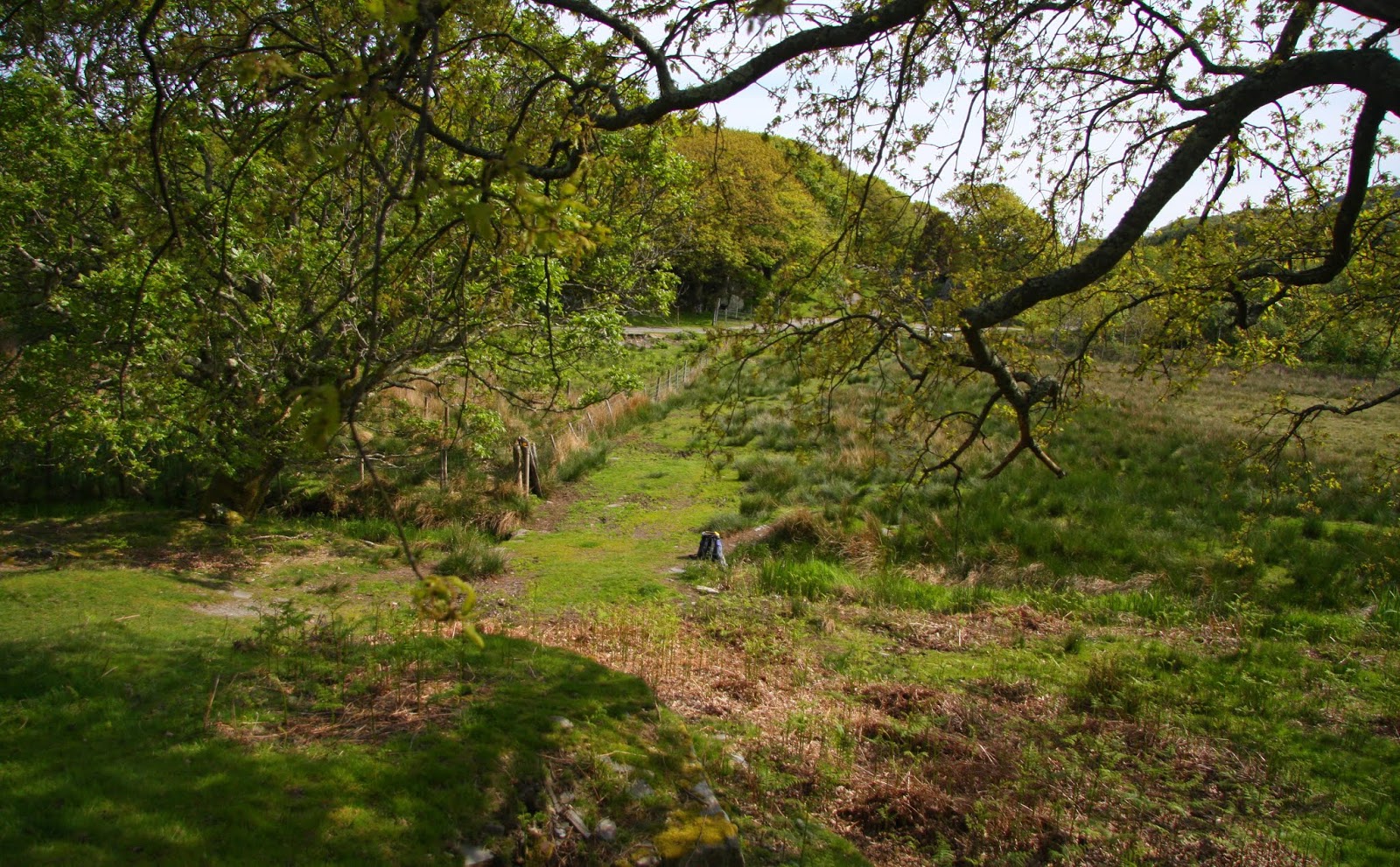
The next point to survey
was where extensive LIDAR analysis led me to believe the natural connecting
bwlch between Fegla Fach and Fegla Fawr was once positioned, this land now has a
flat bedded foot bridge that crosses one of many drainage ditches in the area,
as the Trimble gathered data I sat on the lower slopes of another and smaller
grassed and rocky and tree covered lump just to the west of the foot bridge,
I’d studied this connection in depth with LIDAR and it felt unusual to now put
an image and reality to landscape, that I had only previously looked at in
computer software whose detail had been generated from the LIDAR technique.
 |
| Gathering data at the bwlch of Fegla Fach |
 |
| Fegla Fach from its connecting bwlch |
During this time I
watched a number of people in the adjacent caravan site going about their early
morning business and wondered if I could just walk up through the wooded slopes
of Fegla Fach to its summit, signs proclaiming the caravan site to be private
were not encouraging.
 |
| The signs are not encouraging to any budding visitor |
After packing the
Trimble away I asked a small group of people on the caravan site if I could
visit the summit in the wood and was told that I would have to get permission
to do so as it was private land, they kindly directed me to the Fegla Fach Farm
where I met the local farmer and the warden of the site, we chatted about the
name of the hills, the history of the land, the sea defences and the summit of
the hill. I asked for permission to
visit the summit and left after thanking them for their time.
A number of paths lead
toward the top of Fegla Fach, some are narrow and others broad and
gravelled. The upper part of the hill
has a variety of structures on top, including a wooden hut, rope-bridge, a
large awning resembling a tipi and a high climbing wall.
I judged the summit to be a large rock embedded amongst stunted trees.
 |
| The summit of Fegla Fach is amongst the trees on the left |
 |
| The large rock at the summit of Fegla Fach |
I spent a number of
minutes walking between the various structures close to the summit and visited
all high points before descending one of the broad paths and then coming across
the high climbing wall; all were unexpected and rather surreal.
 |
| Rope-bridge |
 |
| Just one of many things in the Fegla Fach wood |
 |
| Climbing wall |
Leaving the wooded
surrounds I re-entered the caravan site and followed the land beside the river
for a short distance westward, watching a wind-surfer float in to a tiny bay
and enjoying a different perspective of Fegla Fawr. I felt a little sad that such a beautiful
place had to place private signs on gates and the residents were cautious in
relation to me, as even when emerging out of the wood and greeting a man beside
one of the caravans with a cheery; ‘good morning’ I was greeted back with ‘who
are you and what are you doing here’.
 |
| Windsurfer with Fegla Fach in the background |
 |
| Fegla Fawr with the Mawddach Crescent as foreground |
After taking a number of
photographs I headed back to my awaiting car on the continuation of the public
footpath and then on the tracked section of the Mawddach Trail, it was then
time to visit a number of farmers in the Abertrinant and Dysynni area making
further place-name enquiries of hills I had visited a few days earlier.
Survey Result:
Fegla Fawr
Summit Grid Reference: SH 62966 14665
Bwlch Height: 1.9m (LIDAR)
Bwlch Grid Reference: SH 62599 14119 (LIDAR)
Drop: 57.6m (Trimble summit and LIDAR bwlch)
Dominance: 96.81%
Fegla Fach
Summit Grid Reference: SH 63818 15311 (LIDAR)
Bwlch Height: 1.5m (converted to OSGM15)
Bwlch Grid Reference: SH 63692 15129