Showing posts with label Sarah Kerr. Show all posts

Saturday, 9 September 2023

Mapping Mountains – Trimble Surveys – Carnedd Wen


13.07.23  Yr Allt (SJ 242 100, previously Trimbled) 

Yr Allt (SJ 242 100)

It was my pleasure today to join Sarah Kerr on part of her Offa’s Dyke walk.  Sarah had contacted me a few weeks ago and asked if I would like to join her for a few hours as she was walking part of the long distance footpath north of Welshpool.

Considering how wet recent days have been we were ever so fortunate with the weather as although an occasional slow moving shower was forecast for parts of Wales, any grey cloud that materialised did not develop in to rain and our walk remained dry. 

Sarah Kerr

I met Sarah at 8.30am on the Rhallt Lane outside the recently built and large property where she overnighted.  The morning was beautiful with blue sky and the hint of warmth in the air.  It was good to see her as the last time our paths crossed were a number of years ago when trips to Welsh islands and lighthouses were organised.

Prior to meeting I suggested the possibility of including an ascent of Yr Allt from the Rhallt Lane and dropping off the hill back on to the canal towpath which hereabouts also forms a part of Offa’s Dyke footpath.  Sarah was on for this, therefore after pleasantries we walked up the steep lane chatting about all manner of things.  The conversation must have been good as even though I’d been this way a number of times over recent years we overshot the footpath I planned for us to follow.  This meant we remained on the lane as it turned in to a track and we followed it to its high point. 

In the field leading toward the trig pillar

At the end of the track a footpath continues through undergrowth to connect with a forest track, however we now headed to our right on to a steepening field where wild flowers predominated, with a plethora of butterflies flitting this way and that in the warmth of the strengthening sun. 

Approaching the trig pillar

This part of the field forms a ridge that leads ever upward to where the triangulation pillar sits confidently looking north-eastward out toward the Breiddin and the higher hills to the west.  The western horizon was dominated by the Y Berwyn ridge with the higher Aran also on show, with their elongated ridge still battling with wisps of cloud which no doubt would soon be burnt off. 

The distant Y Berwyn

Leaving the trig pillar we lost height heading toward the corner of the lower field, where a stile gives access to another field leading past the large mast that can be seen from many miles away signifying the summit area of this hill.  Shortly beyond is the high point, it doesn’t afford the view that the ground beside the trig pillar does, but it is the summit and therefore with my bagging hat on it had to be visited. 

Sarah at the summit of Yr Allt

To get on to our descent route we now doubled back to the trig pillar and followed the ridge downward past pheasant pens and the Gamekeepers Cottage at the end of the forest track.  Down we went heading toward the Coppice Cottage where many a year ago I used to live.  However, before the cottage is a forest track on the right that heads down through the wood.  I had always wanted to investigate this track and see where it leads.  Having already mentioned this to Sarah she had no objection to us investigating this route.

The track led us down through the wood and seemed to grind to a halt where summer undergrowth of nettles and brambles then took over.  Just below us was a high pheasant fence which conveniently for us had been flattened due to a tree bow falling on it.  However, between us and it was all manner of debris which entailed an assault course to get through, which we eventually did, emerging on to an open field and with the aid of mapping on Sarah’s mobile phone we were soon directed down the field to a footbridge crossing the canal.

After crossing the footbridge we had one barb wired fence to negotiate before reclaiming the canal towpath.  Our onward routes now headed in opposite directions, Sarah farther northward following the footpath of Offa’s Dyke and southward for me back toward Welshpool. 

Sarah heading off on the canal towpath to continue her Offa's Dyke journey 

Before heading our separate ways we had a hug and I thanked Sarah for the invite to join her.  It had been an immensely enjoyable few hours with good company, good conversation and a hill thrown in for good measure!


Survey Result: 


Yr Allt

Summit Height:  231.3m (converted to OSGM15, from previous Trimble GeoXH 6000 survey)

Summit Grid Reference:  SJ 24240 10005 (from previous Trimble GeoXH 6000 survey)

Bwlch Height:  125.9m (LIDAR)

Bwlch Grid Reference:  SJ 21855 08773 (LIDAR)

Drop:  105.4m (Trimble GeoXH 6000 summit and LIDAR bwlch) 

Dominance:  45.57% (Trimble GeoXH 6000 summit and LIDAR bwlch)


For details on the first Trimble GeoXH 6000 summit survey of Yr Allt

For details on the second Trimble GeoXH 6000 summit survey of Yr Allt

For details on the Trimble GeoXH 6000 bwlch survey of Yr Allt

For details on a third visit to the summit of Yr Allt

For details on a fourth visit to the summit of Yr Allt

For details on a fifth visit to the summit of Yr Allt


For further details please consult the Trimble Survey Spreadsheet


Wednesday, 1 June 2016

Mapping Mountains – Trimble Surveys – Garn Fawr


14.05.16  The Smalls (SM 466 088), Emsger (SM 651 226) and Daufraich (SM 661 236)

Emsger, also known as South Bishop (SM 651 226)

The coast around Pembrokeshire has a reputation for beautiful scenery comprising secluded coves, cliffs, sea stacks and islands.  The islands are many, with Ynys Dewi (Ramsey), Skomer and Skokholm being three of the largest in area.  However, dotted around these three islands are a myriad of smaller ones, many are rocky, some have lighthouses situated on them and all are of interest. 

Over the last couple of years Adrian Rayner has organised a number of ‘island adventures,’ usually these are to islands that are not on the tourist trail where daily boats are scheduled to visit and drop people off for a set number of hours before picking them up and whisking them back to the mainland.  The islands Adrian concentrates on are those that are seldom visited and which require a skilled crew to get to, and drop off, and pick up any budding ascensionist.  These island adventures require diplomatic and logistical skills to organise and thanks should be expressed to Adrian for arranging them, as all I have been a part of have been great fun, packed with interest and variety.  Today’s little adventure comprised a visit to The Smalls, Emsger (South Bishop) and Daufraich, with the first two of these islands having lighthouses situated on them.

We met at St Justinian’s which is situated to the west of St David’s and is the departure point for the RNLI Lifeboat, as well as the departure point for Ynys Dewi (Ramsey).  During the previous night a northerly weather front had descended south and left a slight northern breeze which meant that landing on each island was under debate by the crew of our RIB.  The original departure was arranged for 8.00am, and it was nearing 9.30am when the proverbial thumb was lifted in to the air signifying that the adventure was on.

Our RIB for the day

Ayako heading down to board the RIB

As we skimmed across the water toward the southern part of Ynys Dewi the sky was grey and the sea relatively becalmed.  Our first landing destination was The Smalls which as their name implies are a small group of islets, wave battered and remote, and an approximate 12 miles from the western coast of Pembrokeshire.  This small group of islets are the furthest west of any land in Wales, few people visit and even fewer people land.  On our way we approached the landing steps on Emsger and the skipper judged that landing was feasible after visiting The Smalls as the incoming tide would enable us to land higher on the carved out steps that give access to the upper part of the island.

The landing steps on the northern side of Emsger

Leaving Emsger for later that morning we skimmed off west in to a literal sea of seemingly nothingness, the only rock visible was Gwales (Grassholm) and its adjoined West Tump to our south, these are the remotest P15 summits that Wales has to offer and are perched seven miles west of Skomer, they looked weather beaten and almost forgotten except for their colony of Gannets.  As the RIB made progress a small stick stuck out of the sea, just visible it shimmered its presence and as the RIB continued west the stick grew forever larger and slowly took on the shape of a lighthouse, still and grey it stood forlorn, a last vestige of man’s presence before Ireland is reached.


Gwales, also known as Grassholm (SM 598 093)


The Smalls (SM 466 088) - the furthest westerly point of Wales

The Smalls lighthouse has a fascinating history as an incident here in 1800 when one man died and the other lived in sight of his corpse for the following three months before rescue, initiated future three keeper manning.

As the RIB pulled up and lodged its front end against the steps leading on to the slime of copious amounts of seal poo, we clambered off one after another for our all too brief stay on this small but unique part of Wales. 

Approaching The Smalls.  Seated are (L-R) Rob, Sarah, Bob and Jon

The highest natural piece of rock still visible was agreed upon by a number of people and soon the Trimble was positioned on it gathering its customary five minutes of data.  During this time most people roamed the islet finding evidence of the old wooden piles still embedded in the rock that had formed a part of the older lighthouse.

Sheila looking out to sea

Gathering data at the summit of The Smalls, with (L-R) Jon, Bob, Sarah and Rob in the background

Standing on The Smalls felt rather empty, somewhat of a void, our stay was only brief and because of this we all pottered round investigating what the islet had and doing so as quickly as possible, when this happens time is taken up as is concentration, but even compensating for this the islet is still a forgotten place, an end of something rather than a beginning, a flatbed of wave battered emptiness that must be hell on earth during storms, the thought of manning the old lighthouse that supposedly shuddered during storms fills me with dread.

Wave battered and forlorn, the last vestige of land before Ireland

Sheila joining Adrian on the RIB with Sarah and Bob waiting their turn.  These steps were covered in seal poo and extremely slippy

Once back on the RIB we headed toward Emsger, which has at least two rows of carved steps signifying a landing place, we approached the ones on the island’s north.  On the way I spotted the first Puffins that to my knowledge I’ve ever seen, I was struck with how cute and small they are, almost like a sea budgie with little wings flapping ten to the dozen and with tiny little bodies.

(L-R) Daufraich, Emsger (South Bishop), Carn Llidi (mainland Pembrokeshire) and Carn Ysgubor on Ynys Dewi (Ramsey)

As we approached Emsger (South Bishop) the cloud had broken revealing patches of blue sky which according to the sea mariners aboard the RIB would herald choppier sea conditions.  Again the RIB was manoeuvred in to place with its front end lodged relatively firmly against the rock next to the landing steps and one by one we clambered on to the rock.  This island forms a part of the chain known as the Bishops and Clerks which stretch northward and take in Daufraich, Carreg Rhoson and North Bishop, with the latter two aligned south-west to north-east as rocky lumps of ribbed islets.

The south-eastern side of Emsger


Daufraich (SM 661 236)


Carreg Rhoson (SM 667 254)


(L-R) North Bishop, Carreg Rhoson and Daufraich


Emsger (SM 651 226)

The carved rock steps led steeply up toward the island’s lighthouse which was constructed in 1839, with it being automated and demanned in 1983.  The whole upper part of the island is now a part of the lighthouse and its surrounding ground, any vestige of natural earth or rock was on the periphery of this, with the natural high point of the island long since gone with it either buried under the construction or levelled due to the impending construction of the lighthouse.  Consensus of opinion gave the remaining high point as a scrub bit of earth adjacent to a corner at the base of one of the walls, this at least was convenient for Trimble placement and within a few minutes it was gathering data perched on the wall 0.99m above the patch of earth.

Bob getting on to dryish land on Emsger


Bob and Sarah heading up the steps


Rob and Adrian on the final steps to the lighthouse


Gathering data 0.99m above the highest remaining natural ground that was found

After the Trimble was closed down and packed away I walked down to the helipad which was constructed in 1971.  This gave views back up toward the lighthouse and across the carved westerly steps toward the remainder of the Bishops and Clerks.  By now our stay on Emsger was nearing its end and as I clambered back up the steps and round the lighthouse to the steps on the island’s northerly section people were making their way down to the RIB which had been circling the island during our stay.  Emsger is a great lump of rock which if not for the steps up to its lighthouse would prove a difficult place to get to the top of; it stands squat in the sea as an up thrust of rock with its beacon now signalling its position.

Adrian on the helipad with our RIB circling the island


Looking toward the lighthouse from the helipad


Beyond the westerly steps with North Bishop, Carreg Rhoson and Daufraich in the background


The RIB approaching to pick us up from Emsger

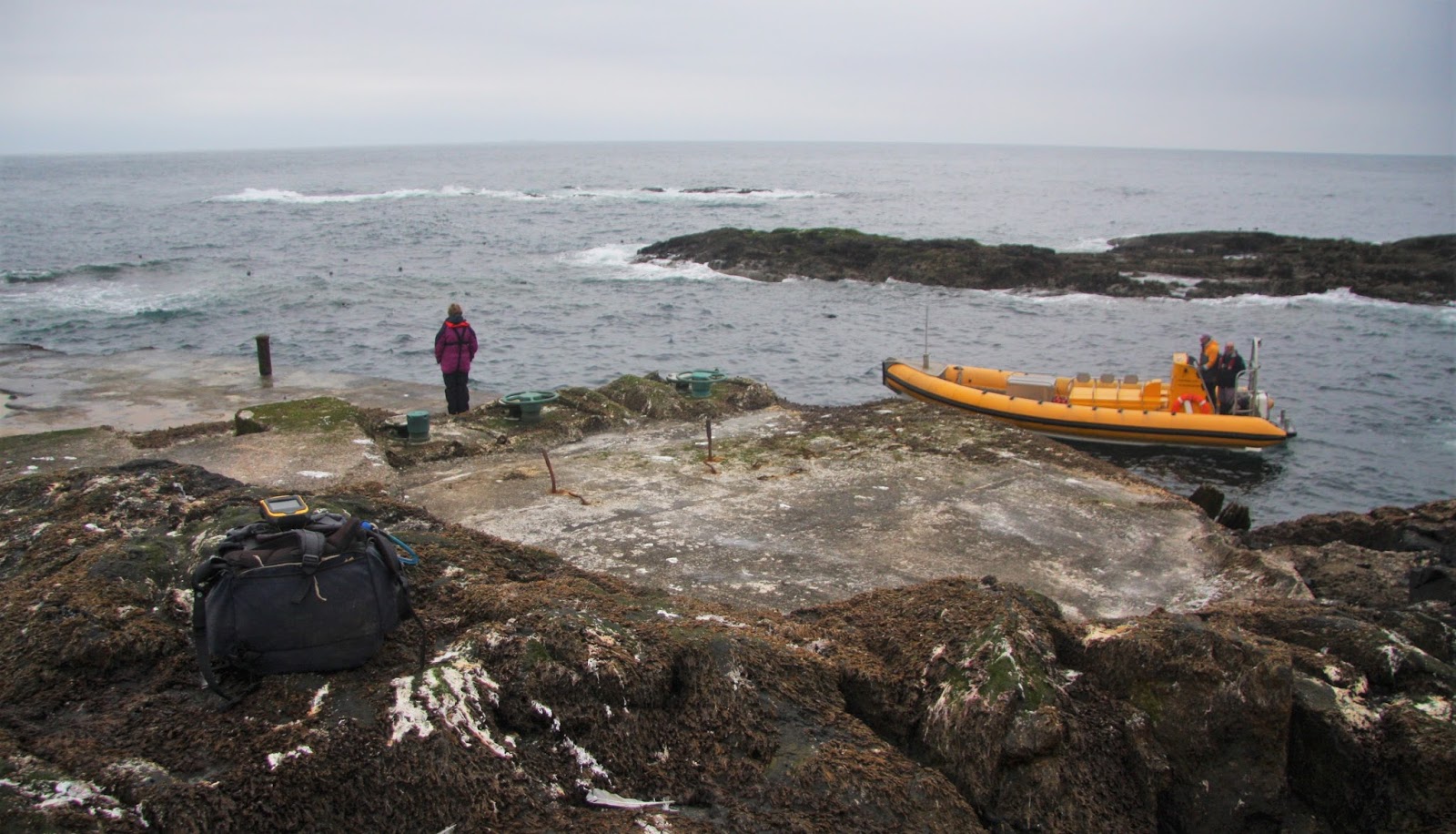
Once we were all safely in the RIB we headed toward Daufraich and approached it from its north.  The main island of Daufraich consists of two parts, with the most easterly given a 20m spot height on Ordnance Survey maps, this looked relatively easy to get to the top of once landed, however the higher 21m map heighted part of the island is its westerly section and this looked decidedly harder to get to the top of, although it did look doable.  As the RIB approached we still didn’t know if the skipper would take us in to attempt a landing, and as we neared the rock it suddenly came apparent that the go ahead had been given and Jon, Rob, Adrian and Bob all made a move toward the front of the RIB, with Ayako, Sheila and Sarah all wisely staying put, not wanting to be put off by a bit of wave battered steep and scrambly rock which for one slip would mean a decidedly wet and somewhat dangerous immersion in the Irish sea, I followed.

Approaching Daufraich


Our route went up somewhere just left of centre

Thankfully the rock proved relatively dry and was not slippy, this gave us all good purchase and although the going was steep there were adequate hand and foot holds to be found.  My confidence on rock is not as it once was, partly because I rarely have necessity to scramble on it these days, and therefore when confronted with 20m of scrambly rock perched above bottomless depths my mind and body goes AAARRRGGGHHHHHHH.  However, all was fine, fine, fine and I followed the others up to the summit.

Somewhere below was the route we'd just come up

The westerly part of Daufraich has two summits, both given the same 21m spot height on Ordnance Survey maps and ideally both needed surveying but time dictated that only one could, and all present agreed that the higher summit was the one that we were standing on, and as the others went over to visit the other 21m map heighted top I positioned the Trimble on what looked to be the true summit and it beeped away perched on its rock as gulls circled overhead and the RIB slowly manoeuvred back toward our landing spot. 

Gathering data at the summit of Daufraich


Carreg Rhoson (SM 667 254)


The Trimble set-up position at the summit of Daufraich

As the Trimble gathered its data I walked over to the other summit and joined Jon, Rob, Adrian and Bob as they assessed which was higher, it was a close call, but the one where the Trimble was positioned received our vote for being the higher. 


Jon checking his hand-held GPS near the summit of Daufraich

Heading toward the second 21m map heighted summit that consensus of opinion gave as slightly lower


Jon at the summit of Daufraich

It was now time to go and I walked back to the Trimble to close it off, take a few photos of its set-up position and set off down the rock to join the others on our downward route.  Rob and Bob partly guided me down and I’m thankful that they did, and after a few minutes of nerve jangling perched over the watery depths we were safely seated in the RIB and the skipper span it round and headed toward the southerly coast of Ynys Dewi (Ramsey).

Jon, Adrian and Bob at the start of the scramble down


Safely back on the RIB and leaving Daufraich

The southerly coastline of this island proved wonderful to see with steep and rock chopped islands butting out of the sea, set against the crumbled cliff line of Ynys Dewi.  The RIB was taken between many of these smaller islands and underneath their sheer cliffs, many plunging directly down from small grassed summits above.  It proved a wondrous place to see as we slowly meandered past the sculptured islands and through a cave where sunlight glimmered across the rock and sea.

The eastern cliffs of Carn Llundain


Rounding the southern part of Ynys Dewi (Ramsey)


Heading through the cave


Being watched

All that remained was a speedy whizz across the sea past The Bitches rocks toward our departure point at St Justinian’s.  It had been another fantastic experience visiting places that few people ever get the opportunity to see let alone stand on, and thanks to Adrian for organising the trip and to Venture Jet for their professionalism and taking us to some of Wales’ more remote islands.


Survey Result:


The Smalls

The summit data for The Smalls did not process, the first data set that has not done so with the Trimble, with the following remark appearing whilst processing:  A position has been detected that is not compatible with the current coordinates.  Perhaps an Irish base station was picked up during data logging or perhaps The Smalls are just so far out in the Irish Sea that coordinates do not exist for processing data!


Emsger (significant name change)

Summit Height:  33.8m (converted to OSGM15) (significant height revision)

Summit Grid Reference:  SM 65116 22619

Bwlch Height:  N/A (island)

Bwlch Grid Reference:  N/A (island)

Drop:  33.8m

Dominance:  100.00%


Daufraich

Summit Height:  21.7m (converted to OSGM15)
 
Summit Grid Reference:  SM 66199 23673 (summit relocation)

Bwlch Height:  N/A (island)

Bwlch Grid Reference:  N/A (island)

 
Dominance:  100.00%


Monday, 12 October 2015

Mapping Mountains – Trimble Surveys – Mynydd Twr


13.09.15  Ynysoedd y Moelrhoniaid (SH 267 947) and Ynys Arw (SH 266 945)   

Ynysoedd y Moelrhoniaid (SH 267 947)

The islets of Ynysoedd y Moelrhoniaid lie like a rough pearled necklace, wave battered 3 kilometres (1.9 miles) off the north-west coast of Ynys Môn.  They form a compact archipelago oriented north-east to south-west and stare back on their much larger island neighbour.  Perched on their highest point is The Skerries Lighthouse, with the word Skerry deriving from the Old Norse ‘sker,’ which means a small rocky reef or island, with the Welsh name for the islands translating as ‘the islands of Bald-headed Grey Seals’.

Our visit to these islands was organised by Adrian Rayner via Rib Ride, who are based in Holyhead and run a variety of trips around the north-west coast of Ynys Môn.  We met at Holyhead Marina and congregated in the café and waited for Adrian’s arrival.  There were 12 booked for this trip; George Morl, Alan Holmes, Alex Cameron, Douglas Law, Bob Kerr, Sarah Kerr, Tony Jenkins, Rob Woodall, Sheila Glew, John Glew, Adrian Rayner and me, also with us was Gordon Adshead who had come to see us off.

(L-R) Alex, Gordon, Adrian, John, Sheila, George, Tony, Alan, Sarah, Bob, Doug, Charles (skipper) and Rob

Charles; our skipper for the day

Once the formalities had been conducted beside the RIB we climbed aboard for a rather luxuriant passage out to sea.  The RIB used for this trip was once owned by Bear Grylls and his name and image is still used in Rib Ride’s promotional material.  The RIB was rather plush with a central cabin which had fold out canopied sides to use when the weather was rough, and an option for seated or standing position behind the controls and which was protected by a Perspex screen.  Behind this was a seat long enough for five people and in front was seating for five or six people.

At the front of the RIB


And at the back of the RIB.  Photo: RibRide

The forecast for the afternoon was good, and we had been lucky as no more than two days prior to today it was predicted that rain was going to envelop this part of the country for the whole afternoon.  As we pulled out from Holyhead the sky cast out colour and the sea was becalmed.  Beyond the harbour breakwater there was a light swell as we proceeded across the straight between Ynys Môn and Ynysoedd y Moelrhoniaid, but conditions proved relatively calm.

It’s a wonderful experience nearing an island, watching as it forever gets larger on the horizon, and today it was the islands Lighthouse that dominated the view as it stood firmly in place attached on the highest part of the archipelago with its white coloured exterior set against the backdrop of a sun drenched grey sky. 

The Skerries Lighthouse

The RIB slowly rounded the western side of the islands and was manoeuvred into the small bay below the Lighthouse.  This entrance was magical as we were suddenly transported in to a different world full of lazy seals whooping their guttural calls and an assortment of small, delightful islets, all ready for us to explore.

Seals relaxing in the afternoon sun

Once the RIB had been secured onto the iron barred ladder leading vertically up the sides of rock we clambered up and started our exploration of the islands.  It seems that there is a need to head toward the high point of any hill or island and today was no exception.  The path leading up to the Lighthouse led through a beautiful array of white daisies, all looking up with their colour mixed in their green rooted grass, set against the white of the Lighthouse they resembled a mountain meadow in spring.

Bob, followed by Alan, climbing up the ladder onto the island


Bob and Sarah with The Skerries Lighthouse in the background


The carpet of flowers

As I walked around the Lighthhouse the ground dropped steeply away to the east and the coastline of Ynys Môn gleamed back in its hazy afternoon light.  There were two potential summit points, one on the southern side of the Lighthouse and the other on the western side.  There was consensus between myself, Alan and one or two others that the highest point was on the southern side, this high point consisted of a rock that was positioned just under the base of the walkway which encircled much of the eastern and southern side of the Lighthouse, however the highest rock was pinned in with buildings either side of it, this had potential to disrupt satellite coverage, and as I set the Trimble up with its internal antenna aligned to the high point of what remains of the natural rock I thought it would take a long time for the 0.1m accuracy level to be attained before logging should start.  Remarkably this accuracy level was attained within a couple of minutes and I quickly pressed ‘Log’ and hid behind a rock, we’ll have to see what the processed data is like and whether the data set is good or has been compromised by the position of the Trimble.

Gathering data at the summit of Ynysoedd y Moelrhoniaid


Charles and Alan look on with the Trimble positioned on the highest natural rock that still exists on Ynysoedd y Moelrhoniaid

Once summit data were collected I headed to the western side of the Lighthouse wanting to gather another five minute data set from the other potential summit position, this was straight under the side of the Lighthouse and after waiting ten minutes the accuracy level was only down to 0.19m, and whilst waiting I looked out on everyone exploring the other islets, so I decided to switch the Trimble off and start doing likewise.

The Trimble positioned on the high point on the western side of the Lighthouse

The highest islet where the Lighthouse is situated has another islet to its south-west named Ynys Arw; this has two main high points, with the southerly of these being the highest.  There were already a number of people scampering all over these high points and I headed over to join them.  This south-westerly islet is cut off from the others at high tide but the pebbles and seaweed of relatively dry land had been exposed as low tide enabled us to visit farther afield from the main islet.

Sarah, Alex and Rob (on left of photo) on the adjacent high point to the Lighthouse with the summit of Ynys Arw on the right of photo


Alex and Rob heading over to Ynys Arw
Sarah below the Lighthouse, with its lower rocks on the right of this photo

John helped me find the scramble down a rock shelf onto the connecting land between the islets and I soon joined Adrian, Rob and Alex on the high point.  Adrian and Alex soon headed off and I remained with Rob for a few minutes talking about the Welsh Remotest list and Alan’s Sibs list, with the furthest northerly island which is named Ynys Berchen, being listed within each as a Pellennig and a Sub-Sib, Rob asked the criteria for the Pellennig list and wondered whether the small islet we were on would meet the minimum drop of 15m.  As he headed off toward the northerly Pellennig / Sub-Sib I set the Trimble up and gathered another five minutes of data from the high point of the southerly islet.

Alex scrambling back up the rock on his way past the Lighthouse toward Ynys Berchen


The Skerries Lighthouse from the summit of Ynys Arw


Ynysoedd y Moelrhoniaid bathed in sunshine
The northerly island of Ynys Berchen which is listed as a Pellennig and Sub-Sib

As the Trimble did its stuff I happily stared out on this stunningly beautiful place, content to be on my own soaking up its ambience.  By this time a few people were gathering, waiting to descend toward the RIB, and once the five minutes of allotted data were collected, I took a few photos with the Lighthouse shining white as a slight breeze blew in from the sea.

Gathering data from the summit of Ynys Arw

As I slowly made my way down the wet rock back onto the connecting pebbled and sea weeded land I wondered if I could make it to Ynys Berchen, but after scrambling back up the small rock shelf toward the Lighthouse I peered out and saw four small figures just turning their backs on the summit of the northerly island and heading back towards the Lighthouse.  My chance had gone as it would be unfair to keep everyone waiting another half an hour or so as I went over, gathered data and came back.  On occasions such as this I often reflect and store the memory of want, by doing so it encourages further visits, and these islands deserve that.  All too soon it was time to depart, we headed down to the metalled ladder and got back on the RIB and pulled out of the small, sheltered bay. 

Rob on his way down the ladder to the RIB


Getting ready to leave Ynysoedd y Moelrhoniaid.  Photo: RibRide

On our way back to Ynys Môn the islets of Ynysoedd y Moelrhoniaid were being enveloped by late afternoon high grey cloud as showers pushed in from the Irish Sea.  The RIB swept around their northern extremity before plunging back toward the Marina.  I looked back and the elongated profile of these wonderful rock strewn islets were now dark and silhouetted against the late afternoon sky, their illuminated colour now gone, replaced with a heartening profile of mystery and beckoning. 


The last view of Ynysoedd y Moelrhoniaid, now no more than a silhouette


Survey Result:


Ynysoedd y Moelrhoniaid 

Summit Height:  21.7m (converted to OSGM15) (Double Sub Twmpau addition)

Summit Grid Reference:  SH 26777 94759

Bwlch Height:  not applicable

Bwlch Grid Reference:  not applicable

Drop:  21.7m

Dominance:  100.00%


Ynys Arw 

Summit Height:  15.2m (converted to OSGM15, Trimble GeoXH 6000) (significant height revision)

Summit Grid Reference:  SH 26647 94598 (Trimble GeoXH 6000)

Bwlch Height:  0.0m (LIDAR)

Bwlch Grid Reference:  SH 26690 94671 (LIDAR)

Drop:  15.2m (Trimble GeoXH 6000 summit and LIDAR bwlch) (Pellennig addition confirmed) 

Dominance:  100.00% (Trimble GeoXH 6000 summit and LIDAR bwlch)


For further details please consult the Trimble survey spreadsheet click {here}

© Crown: CHERISH PROJECT 2019. Produced with EU funds through the Ireland Wales Co-operation Programme 2014-2020. All material made freely available through the Open Government Licence.