Showing posts with label Ffridd Las (SH 660 139). Show all posts

Saturday, 7 April 2018

Mapping Mountains – Trimble Surveys – Cadair Idris


Rob Woodall Completes the Welsh Mainland Tumps

18.02.18  Pared y Cefn Hir (SH 661 148, only bwlch Trimbled), Ffridd Bellau Nant y Gwyrddail (SH 665 139, previously Trimbled) and Ffridd Las (SH 660 139, previously Trimbled)


Ffridd Las (SH 660 139)

Today was quite a momentous one in the annals of hill bagging as Rob Woodall completed the Welsh mainland Tumps, a staggering undertaking with 2,271 hills listed as of the time of completion.

The hill Rob chose for this completion remains unnamed on Ordnance Survey maps, and is known as Ffridd Las by the farmer who grazes sheep on the hill, it is listed as Pen Llynnau Cregennen in the Tumps.

The farmer who grazes Ffridd Las lives at the small farm house of Ffridd Boedel, which is situated beside and directly below the hill to its north-west, and on my way to the lakeside car park where Rob had suggested we all meet, I called at this house and met Carys Lloyd.  We chatted for a number of minutes and I explained my interest in upland place-name research, she kindly suggested I call back nearer lunchtime as her husband; Arwyn, would be in and could help me.

A few minutes later I drove in to the lakeside car park adjacent to the double lakes of Llynnau Cregennan, the day looked fair until early afternoon when light rain was forecast.  This at least was more favourable when compared to recent weather reports as persistent rain and hill mist had been forecast for the morning and remainder of the day.

The positioning of Llynnau Cregennan are beautiful as they sit nestled in the landscape with the looming profile of Pared y Cefn Hir overlooking to the north-east and the higher satellite peaks of Cadair Idris to their south-east.  But it is Pared y Cefn Hir that stands out, butted skyward it defies its relatively lowly height.  Whilst Ffridd Las is almost inconsequential in comparison, a grassed domed small hill beside the minor road that skirts the lakes.  However, this is the appealing factor of the Welsh P30s as they take in small and high hills alike, rock strewn giants and mere grassed grazing fields, well-trodden paths and seldom visited places, and it is their variety that encourages investigation.

Pared y Cefn Hir and the northerly of the Llynnau Cregennan

Rob had suggested extending his walk over Pared y Cefn Hir and its adjacent hill of Bryn Brith, before visiting Ffridd Bellau Nant y Gwyrddail, followed by his last hill; Ffridd Las.  I decided to bi-pass the first two hills of the walk and join the festivities on the last two; this would give me time to visit the small farm house of Ffridd Boedel where I hoped to meet Arwyn Lloyd and confirm the name of the hill that Rob was finishing on.

As the party set off toward Pared y Cefn Hir I remained in the car park chatting with Gordon Adshead who, like me, planned on visiting the last two hills at his leisure.  The morning was ideal for such a walk with the tops clear of clag and a gentle winter light adding substance to the beautiful landscape.

As Rob and friends began to get strung out on their way up Pared y Cefn Hir I sauntered down to the larger and more northerly of the double lakes and watched as a cloud blanket cascaded over the cliffs of Mynydd Moel, a slow and delicate ebb of morning mist following the upper contours of the hill.

Rob and party heading up Pared y Cefn Hir

Although I hadn’t planned on doing so I realised that with time on my hands I could gather a data set from the critical bwlch of Pared y Cefn Hir, this is positioned at the outflow of the northern and larger lake.  This position had been surveyed in November 2012 when along with John Barnard and Graham Jackson we spent two days surveying the summits of Pared y Cefn Hir and Bryn Brith and three potential positions of the higher of these two hills connecting bwlch.

Gathering data with the Leica GS15

As I approached the outflow I looked up and Rob and friends were just cresting the summit ridge of Pared y Cefn Hir, I positioned the Trimble on the upper part of the concrete surround at the outflow to the northern lake, thankfully the concrete surround was just wide enough for the Trimble to be positioned without any possibility of being dislodged.

After measuring the offset between the Trimble’s internal antenna and the gravel and rock at the base of the water I stood back and waited for it to attain the 0.1m accuracy level before data should be logged, this was achieved relatively quickly and after pressing ‘Log’ I wandered away from the equipment’s quiet beeps and happily contented myself with taking photos across the water to the grassed and curved profile of Ffridd Las.

The bwlch of Pared y Cefn Hir

Initially I planned on collecting five minutes of data, but as I had no time constraint I thought ten minutes would be sufficient.  During data collection a couple walked my way on the narrow minor road, they stopped and we chatted, by the time they headed off over 20 minutes of data had been gathered, I then decided that a 30 minute data set would be good!

Gathering data at the critical bwlch of Pared y Cefn Hir

Once data were stored and the Trimble packed away I walked up the road to Ffridd Boedel where Arwyn met me in his slippers, after explaining my interest in the names of adjacent hills he put his boots on and we spent a contented 30 minutes above his farm talking about the hills, their names, the ffriddoedd and his life as a farmer.

Arwyn Lloyd of Ffridd Boedel

I only left when we spotted the large party descending Pared y Cefn Hir and taking the path heading east around the northern shore of the larger lake, realising that they were not heading up the minor road where I planned on joining them I thanked Arwyn for his time and then headed toward the summit of Ffridd Bellau Nant y Gwyrddail.

As I approached the summit of Rob’s penultimate Welsh mainland Tump the strung our party were rounding the shore of the southerly lake and heading up the south-west flank of the hill.  They were soon on the summit.

Approaching the summit of Ffridd Bellau Nant y Gwyrddail

At the summit of Ffridd Bellau Nant y Gwyrddail

All that remained was the walk back down from the summit of Ffridd Bellau Nant y Gwyrddail and the short walk over toward the summit of Ffridd Las, the last hill of many for Rob, all 2,271 of them!

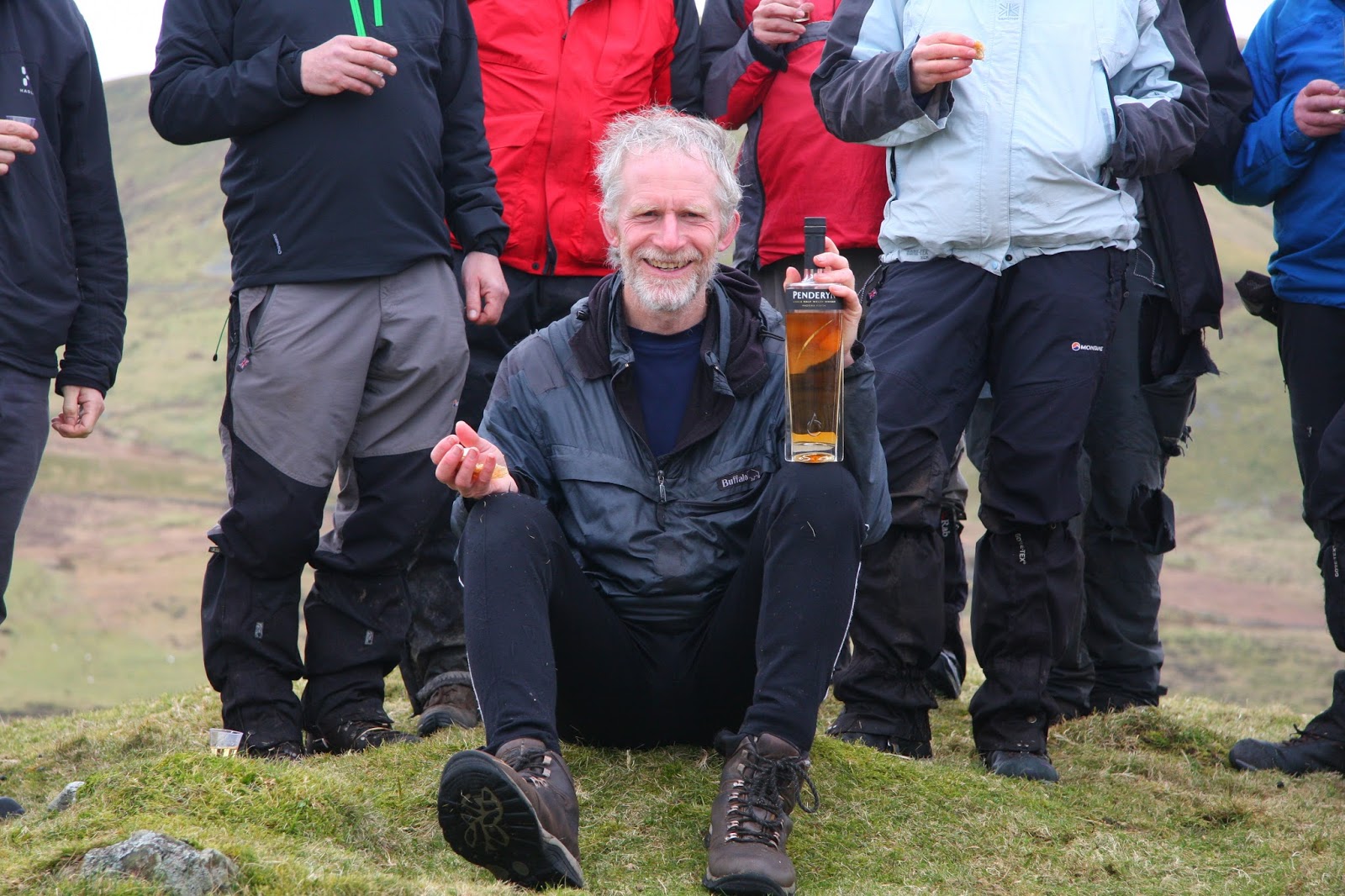
Rob was greeted at the summit of Ffridd Las by 14 people with the customary arch of ceremonial walking poles leading toward the high point of the hill; this was a fitting end to an unprecedented achievement.  We stood and sat beside the summit sampling a variety of cake toasting Rob’s latest amongst many incredible achievements.

At the summit of Ffridd Las

Rob completes the Welsh mainland Tumps on the summit of Ffridd Las

Visiting the Welsh P30s is something that I have enjoyed for many years, their variety seems to have no bounds, and they have brought me so many enjoyable experiences, with each one however small in height or grand in stature bringing its own unique charm and ambiance.  To have visited them all on the mainland must be such a fulfilling experience and my congratulations go out to Rob for being the first person to have done so.    
 
   
Survey Result:


Pared y Cefn Hir

Summit Height:  383.1m (converted to OSGM15, from previous Leica GS15 survey) (Sub-Trichant reclassified to Trichant)

Summit Grid Reference:  SH 66199 14885 (from previous Leica GS15 survey)

Bwlch Height:  233.7m (converted to OSGM15, Trimble GeoXH 6000)  233.7m (converted to OSGM15, Leica GS15)

Bwlch Grid Reference:  SH 65822 14423 (Trimble GeoXH 6000 and previous Leica GS15 survey)

Drop:  149.4m (from previous Leica GS15 survey)

Dominance:  39.00% (from previous Leica GS15 survey)


Thursday, 29 March 2018

Mapping Mountains – Significant Name Changes – 200m Twmpau


Ffridd Las (SH 660 139)

There has been a Significant Name Change to a hill that is listed in the 200m Twmpau, with the summit height, drop and status of the hill being confirmed by a Trimble GeoXH 6000 survey which took place on the 17th February 2018.

The criteria for the list that this name change applies to are:

200m Twmpau – All Welsh hills at and above 200m and below 300m in height that have 30m minimum drop, with the word Twmpau being an acronym standing for thirty welsh metre prominences and upward.  With an accompanying sub category entitled the 200m Sub-Twmpau consisting of all Welsh hills at and above 200m and below 300m in height that have 20m or more and below 30m of drop.

The hill is adjoined to the Cadair Idris range of hills which are situated in the south-western part of North Wales (Region A, Sub-Region A3), and it overlooks the double lakes of Llynnau Cregennan which are to its north and north north-east respectively and the small community of Arthog towards its west north-west. 

Ffridd Las (SH 660 139)

The hill appeared in the 200m P30 list on Geoff Crowder’s v-g.me website under the invented name of Bryn y Arthog with an accompanying note stating; Name from stream to the South.  During my early hill listing I thought it appropriate to either invent a name for a hill, or use a name that appeared near to the summit of the hill on Ordnance Survey maps of the day.  My preference was to use farm names and put Pen, Bryn or Moel in front of them, or as in this instance, use the name of a stream.  This is not a practice that I now advocate as with time and inclination place-name data can be improved either by asking local people or by examining historical documents, through this form of research an appropriate name for the hill can usually be found, and in the case of this hill it was the local farmer who grazes sheep on the land that the summit of the hill is situated on who gave the name of Ffridd Las.


Bryn y Arthog
    279m
    SH661140
    124
23
    Name from stream to the South


The local farmer is Arwyn Lloyd who farms from Ffridd Boedel which is situated directly below the hill to its north-west.  Whilst visiting this hill I called at this small farm house and met Arwyn, who is a Welsh speaker and has lived at Ffridd Boedel for 40 years.  We spent the next 30 minutes talking about the hills and their names, the ffriddoedd to the south-west of his farm, his life as a farmer and the name of the hill directly above his farm, Arwyn said that the hill is named Ffridd Las and it is a part of land that his sheep graze.

Arwyn Lloyd

Therefore, the name this hill is now listed by in the 200m Twmpau is Ffridd Las and this name was derived from local enquiry.


The full details for the hill are:

Group:  Cadair Idris

Name:  Ffridd Las

Previously Listed Name:  Bryn y Arthog 

Summit Height:  278.5m (converted to OSGM15)

OS 1:50,000 map:  124

Summit Grid Reference:  SH 66076 13984 
 
Drop:  30.7m (converted to OSGM15)


The Trimble GeoXH 6000 gathering data at the summit of Ffridd Las


Myrddyn Phillips (March 2018)


Sunday, 25 March 2018

Mapping Mountains – Trimble Surveys – Cadair Idris


17.02.18  Ffridd Tyddyn Bach (SH 656 139), Ffridd Tyddyn Mawr (SH 654 140), Ffridd Las (SH 660 139) and Ffridd Bellau Nant y Gwyrddail (SH 665 139)

Ffridd Bellau Nant y Gwyrddail (SH 665 139)

With the weather forecast giving drizzly wet conditions for tomorrow’s walk celebrating Rob Woodall’s completion of the Welsh mainland Tumps, I thought it wise to take advantage of today’s weather and visit these hills to get the surveys out of the way before tomorrow’s festivities.  This would enable me to survey these hills without a time constraint and also concentrate on the land to the west of Llynnau Cregennan and the minor road leading to the car park, as a small bump needed confirmation as a 200m Sub-Twmpau.

Whilst driving west toward Dinas Mawddwy the weather closed in and rain increased in strength, thankfully this ceased by the time I drove through Dolgellau toward my parking spot close to Llynnau Cregennan.  I hadn’t been this way in a number of years and it is another one of those secluded places nestled at the base of much higher hills, but still with an inner beauty all its own.

The higher satellite peaks of Cadair Idris were bathed in low lying cloud as I set off toward the first hill, and across the Afon Mawddach the southerly ridge of the Rhinogydd were again embedded in low cloud which remained steadfast during the following three hours, whilst the lower heighted hills I planned for today were glimmering free of cloud, with early morning sunshine occasionally illuminating their slopes.

Early morning cloud and colour

I wanted to survey three hills, two of which were planned for Rob’s walk tomorrow, the other was the confirmation of the 200m Sub-Twmpau, this hill is unnamed on the map and has three uppermost 270m map ring contours with the furthest north-westerly ring contour having a 274m spot height on the Ordnance Survey Interactive Coverage Map hosted on the Geograph website.

Reaching the first of these 270m ring contours I set the Trimble up on the ground and as it gathered its allotted five minutes of data I stood back and admired the profile of Pared y Cefn Hir, a hill that was the first to be surveyed using the Leica GS15 when still with John and Graham, this is a wonderful hill, rather Scottish in nature, one whose stature defies its relatively lowly height.  This morning the wisps of low cloud were still stubbornly hugging its higher ridge, but its mid and lower slopes were illuminated in early colour, and set against the waters of Llynnau Cregennan it gave a wonderful sight.

Gathering data at the summit of Ffridd Tyddyn Bach (SH 656 139)


Pared y Cefn Hir - a sublime hill

Prior to visiting these hills I’d looked at the Tithe map for boundaries between each and farm land allocation as I hoped to visit at least one farm later in the day and confirm names for each.  The Tithe map gave the land boundary for these three 270m ring contours split between Tyddyn Bach and Tyddyn Mawr, two farms positioned to the north of the hill, with just the latter named on current maps.  These land boundaries consisted of walls, between each was land probably seldom visited by the hill walker, and yet it was stunning in simplicity with wall, bog and hill all contrasting and giving substance to the view.  Land boundaries by their nature are impositions upon the land, they are territorial markers of ownership or grazing rights, they seldom enhance land, as the wild nature of open land will testify, and yet on this morning, the boundaries of walls seemed to justify their existence, they seemed set, permanent and unmoving, an indicator of an old traditional, and one that added perspective and history to this place.

The walled and bounded Ffriddoedd

As I gathered the Trimble after the morning’s first survey I headed northward toward the next 270m ring contour, this was visually lower than the third where the 274m spot height is adjoined, but as I had no time constraint and the weather favourable I thought I’d gather another data set to be completest.

Gathering data at the summit of the second and central 270m ring contour

This second high point proved to be an embedded rock with a small gorse bush smothering it, once five minutes of data were stored I headed toward the higher of the three ring contours and set the Trimble atop my rucksack and waited for the next data set to be gathered.

Gathering data at the summit of Ffridd Tyddyn Mawr (SH 654 140)

Before heading to the next hill I wanted to take at least two data sets from the positions that map contouring indicates are the possibilities for the critical bwlch position of this hill, the first of which was on a green path at the base of a bump, the second of which was in a bog close to the minor road as it skirts the western fringe of the double lakes.

Surveying the bwlch of Ffridd Tyddyn Mawr

After this second bwlch survey I started the ascent of the 279m map heighted hill which is directly above the minor road and the hill that Rob planned on finishing on tomorrow, whilst doing so I looked back at the bog I had just surveyed and decided I should take another data set from its northern extremes, so I backtracked down the hill, set the Trimble up and as it gathered data I noticed a farm vehicle parked outside Ffridd Boedel; a small farm house beside the minor road, and after the Trimble was packed away I knocked on its door, no one was in, but I hoped when here the following day to meet the farmer and ask about the names of these hills.

It was only a short walk, albeit steep, to the high point of what I learnt the next day is the hill known as Ffridd Las, this is the hill Rob planned on finishing on and as the Trimble was set on the ground aligned with the high point of the hill and beeped away gathering its five minutes of data I snook off to a convenient gorse bush and hid a small bottle of Champagne for tomorrow’s celebration.

Gathering data at the summit of Ffridd Las
Zoom in and you can just see the top of the small bottle of Champagne left in the gorse bush for the celebration of Rob's completion of the Welsh mainland Tumps the following day

Leaving the summit of Ffridd Las I headed south to the minor road at the hill’s base and walked the short distance toward a gate, beyond which was my car, from close to this a path heads across the connecting bwlch, this was the point for the next survey.  Before setting the Trimble to gather its next data set I assessed the lay of land from a number of directions and decided that beside this narrow path was as good as any.

Ffridd Las from the south


Approaching Ffridd Bellau Nant y Gwyrddail


Gathering data at the critical bwlch of Ffridd Las with Ffridd Bellau Nant y Gwyrddail in the background

Before visiting the summit of the third hill I wanted to gather data at its connecting bwlch, this is positioned to the north-east of its summit and so I walked on a moorland track and skirted the summit to its north, using gates to access the grazing pasture where the bwlch is situated.

The view north-east from the bwlch of Ffridd Bellau Nant y Gwyrddail

All that remained on this walk was the last survey, the summit of which is situated on land known as Ffridd Bellau Nant y Gwyrddail; which when translated in to English can mean the far off ffridd of Nant y Gwyrddail, with Nant-y-gwyrddail being a farm situated SH 671 143.  This hill’s summit proved a wonderful spot with views stretching down the stream valley toward Llyn Gwernan, across Llynnau Cregennan toward Pared y Cefn Hir and in to the mass of higher hills surrounding Cadair Idris.

Llynnau Cregennan from the summit of Ffridd Bellau Nant y Gwyrddail


Gathering data at the summit of Ffridd Bellau Nant y Gwyrddail

It was a fitting place to end this part of the morning’s surveying activities, but I still had time for one more survey which meant a small drive around the corner of the minor road, but this will be detailed in a separate post.


Survey Result:


Ffridd Tyddyn Bach (significant name change)

Summit Height:  272.0m (converted to OSGM15)

Summit Grid Reference:  SH 65693 13963

Bwlch Height:  259.4m (LIDAR)

Bwlch Grid Reference:  SH 65599 13975 (LIDAR)

Drop:  12.6m (Trimble summit and LIDAR bwlch)

Dominance:  4.66%


Ffridd Tyddyn Mawr (significant name change)

Summit Height:  273.2m (converted to OSGM15)

Summit Grid Reference:  SH 65486 14081

Bwlch Height:  251.2m (LIDAR)

Bwlch Grid Reference:  SH 65928 13997 (LIDAR)

Drop:  22.0m (Trimble summit and LIDAR bwlch) (200m Sub-Twmpau addition)

Dominance:  8.06%


Summit Height:  278.5m (converted to OSGM15)

Summit Grid Reference:  SH 66076 13984

Bwlch Height:  247.8m (converted to OSGM15)

Bwlch Grid Reference:  SH 66369 13783

Drop:  30.7m (200m Twmpau status confirmed)

Dominance:  11.02%


Ffridd Bellau Nant y Gwyrddail (significant name change)

Summit Height:  280.0m (converted to OSGM15)

Summit Grid Reference:  SH 66542 13906

Bwlch Height:  244.6m (converted to OSGM15)

Bwlch Grid Reference:  SH 66859 14241

Drop:  35.4m

Dominance:  12.64%